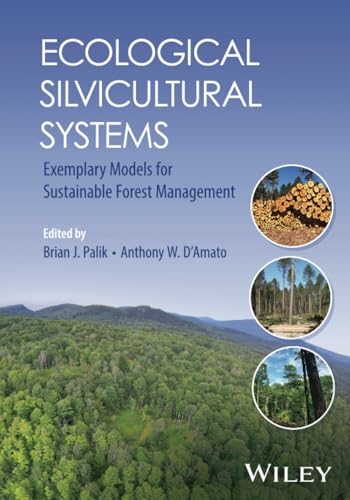
Ecological silvicultural systems: exemplary models for sustainable forest management / edited by Brian J. Palik & Anthony W. D'Amato.
Material type: TextPublication details: Hoboken, NJ : John Wiley & Sons Ltd., c2024.Description: xix, 315 pages : b&w illus.; 25 cmISBN:
 - 9781119890904
- Ref 634.9 Ec73e 2024.
| Item type | Current library | Collection | Call number | Status | Barcode | |
|---|---|---|---|---|---|---|
 Books
Books
|
ASCOT Library - Zabali Campus Reference | Reference | Ref 634.9 Ec73e 2024. (Browse shelf(Opens below)) | Available | Ref6349004786 |
Includes bibliographical references and index.
Contents:
Chapter 1. The Context of Ecological silviculture. - -
Authors: Brian J. Palik, Anthony W. D’Amato. - -
Chapter 2. Ecological silviculture for western Great Lakes red pine ecosystems. - -
Author: Brian J. Palik, Anthony W. D’Amato. - -
Chapter 3. Ecological silviculture for northern hardwood ecosystems of northeastern U.S. - -
Author: Anthony W. D’Amato. - -
Chapter 4. Ecological silviculture of Douglas-fir-western hemlock forests. - -
Author: Abraham Wheeler, Jerry F. Franklin, Stephanie J. Wessell. - -
Chapter 5. Ecological silviculture for longleaf pine woodlands in the southeastern U.S. - -
Author: Steven B Jack, Benjamin O Knapp, R Kevin McIntyre. - -
Chapter 6. Ecological silviculture of southeastern US pine-oak forests. - -
Author: Justin L. Hart, J. Davis Goode, Daniel C. Dey. - -
Chapter 7. Ecological silviculture for conifer wetlands in the western Lakes States. - -
Author: Marcella A. Windmuller-Campione, Laura F. Reuling, Robert A. Slesak, Randy K. Kolka. - -
Chapter 8. Ecological silviculture for southern Appalachian hardwood forests. - -
Author: Jodi A. Forrester, Tara L. Keyser, David K. Schnake. - -
Chapter 9. Ecological silviculture for yellow birch-conifer mixedwoods in eastern Canada. - -
Author: Patricia Raymond, Daniel Dumais. - -
Chapter 10. Ecological silviculture for boreal black spruce in Canada. - -
Author: Miguel Montoro Girona, Martin Alcala Pajares, and Maxence Martin. - -
Chapter 11. Ecological silviculture for Acadian mixedwood forests. - -
Author: Robert S. Seymour. - -
Chapter 12. Ecological silviculture for Sierra Nevada conifer forests. - -
Author: Robert A. York. - -
Chapter 13. Ecological silviculture for aspen mixedwoods in western Canada. - -
Author: S. Ellen Macdonald, Phil G. Comeau, Charles A. Nock, Brad D. Pinno. - -
Chapter 14. Ecological silviculture for North American interior dry pine forests. - -
Author: Andrew J. Larson, Derek J. Churchill. - -
Chapter 15. Ecological silviculture for North American temperate rainforests. - -
Author: Justin S. Crotteau, William J. Beese, John-Pascal Berrill, Robert L. Deal, Constance A. Harrington, Kellen N. Nelson. - -
Chapter 16. Ecological silviculture for Central Hardwood forests and woodlands of the US. - -
Author: Miranda T. Curzon, John M. Kabrick. - -
Chapter 17. Ecological silviculture for Fennoscandian Scots pine ecosystems. - -
Author: Timo Kuuluvainen and Timo Pukkala. - -
Chapter 18. Ecological silviculture for mountain ash forests of Australia. - -
Author: David B. Lindenmayer. - -
Chapter 19. Ecological silviculture for central European beech dominated forests. - -
Author: Thomas A. Nagel, Miroslav Svoboda, Lucie Vítková, Dušan Robenbergar. - -
Chapter 20. Ecological silviculture for Chilean temperate rainforests. - -
Author: Pablo J. Donoso, Daniel P. Soto. - -
Chapter 21. The place of ecological silviculture, now and in the future.
Author: Anthony W. D’Amato, Brian J. Palik. - -
Index. Indexing terms, species, geographic locations, etc.
"For generations, silvicultural systems have focused largely on models whose primary objective is the production of timber, leading to drastically simplified forests with reduced ecological richness, diversity, and complexity. Ecological silviculture, by contrast, focuses on producing and maintaining forests with “all their parts”, that is, with the diversity and flexibility to respond and adapt to global changes. Ecological silviculture seeks to emulate natural development models and sustain healthy forests serving multiple values and goals.
Ecological Silvicultural Systems provides a comprehensive introduction to these approaches and their benefits tailored to diverse types of forests, designed for forest management professionals. It provides a series of exemplary models for ecological silviculture and surveys the resulting forest ecosystems. The result is a text that meets the needs of professionals in forestry and natural resource management with an eye towards sustaining healthy forest ecosystems, adapting them to climate change, protecting them from invasive species, and responding to changing market forces.
Ecological Silvicultural Systems readers will also find:
Detailed treatment of forest ecosystems in North America, Europe, South America, and Australia
A broad field of contributors with decades of combined expertise on multiple continents
Discussion of pine woodlands; temperate hardwood forests, boreal forests, temperate rainforests, and more.
Ecological Silvicultural Systems is a useful reference for professional foresters, wildlife habitat managers, restoration ecologists, and undergraduate and graduate students in any of these fields." -- Provided by publisher
There are no comments on this title.