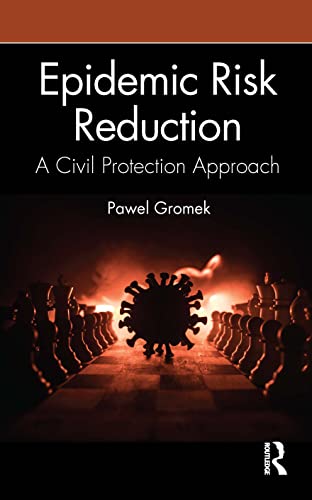
Epidemic risk reduction: a civil protection approach / by Pawel Gromek.
Material type: TextPublication details: New York, NY : Routledge, c2023.Description: xiii, 293 pages : col. illus. ; 23 cmISBN:
 - 9781032181004
- Ref 363.348 G89e 2023.
| Item type | Current library | Collection | Call number | Status | Barcode | |
|---|---|---|---|---|---|---|
 Books
Books
|
ASCOT Library - Zabali Campus Reference | Reference | Ref 363.348 G89e 2023. (Browse shelf(Opens below)) | Available | Ref3633404844 |
Includes bibliographical references, appendices, and index.
Chapter 1. Specific nature of epidemic hazards. --
Chapter 2. Development mechanisms of infections and contagions. --
Chapter 3. Networks of hazards related to epidemic. --
Chapter 4. Epidemic risk and general ways to deal with it. --
Chapter 5. Strategic assessment of epidemic risk. --
Chapter 6. Ad hoc risk assessment. --
Chapter 7. Post-epidemic risk assessment. --
Chapter 8. Civil protection in epidemic risk reduction. --
Chapter 9. Conclusion. --
References.
"Epidemic Risk Reduction: A Civil Protection Approach focuses on disaster risk reduction (DRR) relative to epidemic outbreak and the concept of civil protection and public safety. First and foremost, the primary role of public officials and agencies—including police, military, public health, and emergency management and response professionals—must be the safety and security of citizens. The book provides practical solutions and policies that can be enacted and instituted to protect human life and health as well as property and environment in the scope of human survival, providing essential services, and providing for peoples’ basic needs.
The author examines epidemics as disasters, similar to natural hazards or other large-scale events that require planning, preparedness, mitigation, and response. The approach is unique in looking at tools for risk assessment and strategic planning formulated around civil protection measures as a means to reduce and mitigate risk. Often, preparedness and response planning is siloed with an epidemiological and medical response at the forefront. While absolutely important and essential, doing so—in conjunction with coordinated government efforts to provide necessary supplies, security, and logistics—is equally critical to meet the public’s needs and provide a coordinated response."-- Provided by publisher.
There are no comments on this title.