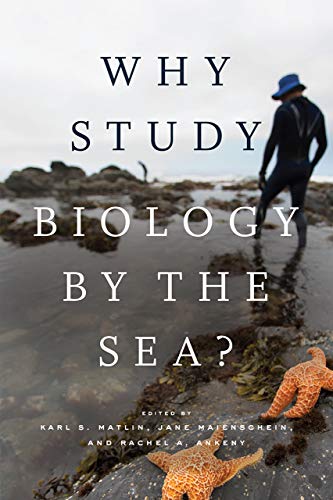
Why study biology by the sea? / edited by Karl S. Matlin, Jane Maienschein, and Rachel A. Ankeny.
Material type: TextPublication details: Chicago, IL : The University of Chicago Press , c2020.Description: x, 355 pages : b&w illus. ; 23 cmISBN:
 - 9780226672939
- Ref 578.77 W62w 2020.
| Item type | Current library | Collection | Call number | Status | Barcode | |
|---|---|---|---|---|---|---|
 Books
Books
|
ASCOT Library - Zabali Campus Reference | Reference | Ref 578.77 W62w 2020. (Browse shelf(Opens below)) | Available | Ref5787704845 |
Browsing ASCOT Library - Zabali Campus shelves, Shelving location: Reference, Collection: Reference Close shelf browser (Hides shelf browser)

|

|

|

|

|

|

|
||
| Ref 577.3 R58m 2024. Monitoring forest biodiversity for improving conservation / | Ref 577.7 W31m 2023. Marine ecology: concepts and applications / | Ref 578.77 M36c 2023 Corals and reefs: from the beginning to an uncertain future / | Ref 578.77 W62w 2020. Why study biology by the sea? / | Ref 579.177 M92m 2020 Marine microbiology: ecology and applications / | Ref 580 P19b 2024. Botany: an introduction to plants and their adaptations / | Ref 580.3 Il68i 2021 C2 Illustrated dictionary of botany / |
Includes bibliographical references and index.
Foreword. --
Introduction. --
Part One Marine Places. --
1 Why Have Biologists Studied at the Seashore? The Woods Hole Marine Biological Laboratory. --
2 Marine Biology Studies at Naples: The Stazione Zoologica Anton Dohrn. --
3 The First Marine Biological Station in Modern China: Amoy University and Amphioxus. --
4 The Misaki Marine Biological Station’s Dual Roles for Zoology and Fisheries, 1880s–1930s. --
Part Two Marine Practice. --
5 Illuminating Animal Behavior: The Impact of Laboratory Structure on Tropism Research at Marine Stations. --
6 The Scientific Fishery: Sampling, Dissecting, and Drawing in the Gulf of Naples. --
7 A Dual Mission: Research and Education as Critical Factors for the Scientific Integrity of the Marine Biological Laboratory. --
8 Francis O. Schmitt: At the Intersection of Neuroscience and Squid. --
9 Microscopes and Moving Molecules: The Discovery of Kinesin at the Marine Biological Laboratory. --
10 Using Repertoires to Explore Changing Practices in Recent Coral Research. --
11 Why Study Sex by the Sea? Marine Organisms and the Problems of Fertilization and Cell Cleavage. --
12 Hagfish and Vascular Biology: Why the Marine Model Matters. --
Epilogue: The Future of Biological Research Will Be Found in the Oceans, Alejandro Sánchez Alvarado. --
Acknowledgments. --
List of Contributors. --
Index.
"For almost a century and a half, biologists have gone to the seashore to study life. The oceans contain rich biodiversity, and organisms at the intersection of sea and shore provide a plentiful sampling for research into a variety of questions at the laboratory bench: How does life develop and how does it function? How are organisms that look different related, and what role does the environment play?
From the Stazione Zoologica in Naples to the Marine Biological Laboratory in Woods Hole, the Amoy Station in China, or the Misaki Station in Japan, students and researchers at seaside research stations have long visited the ocean to investigate life at all stages of development and to convene discussions of biological discoveries. Exploring the history and current reasons for study by the sea, this book examines key people, institutions, research projects, organisms selected for study, and competing theories and interpretations of discoveries, and it considers different ways of understanding research, such as through research repertoires. A celebration of coastal marine research, Why Study Biology by the Sea? reveals why scientists have moved from the beach to the lab bench and back."--Provided by publisher.
Text in English.
There are no comments on this title.