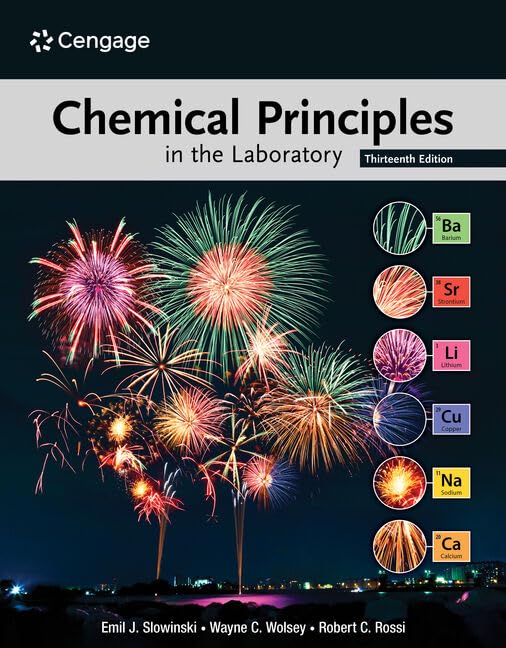
Chemical principles in the laboratory / by Emil J. Slowinski, Wayne C. Wolsey, and Robert C. Rossi.
Material type: TextPublication details: Boston, MA : Cengage Learning, Inc., c2024.Edition: 13th edDescription: xi, 420 pages : b&w illus. , figs. ; 28 cmISBN:
 - 9780357851272
- Ref 542 Sl59c 2024
| Item type | Current library | Collection | Call number | Status | Barcode | |
|---|---|---|---|---|---|---|
 Books
Books
|
ASCOT Library - Zabali Campus Reference | Reference | Ref 542 Sl59c 2024 (Browse shelf(Opens below)) | Available | Ref5420005008 | |
|
Books
|
ASCOT Library - Zabali Campus Reference | Reference | Ref 542 Sl59c 2024 (Browse shelf(Opens below)) | Available | Ref5420005009 |
Browsing ASCOT Library - Zabali Campus shelves, Shelving location: Reference, Collection: Reference Close shelf browser (Hides shelf browser)

|

|

|

|
|

|

|
||
| Ref 536.3 H83t 2023 Thermal radiation: an introduction / | Ref 536.7 B64f 2022 04637 Fundamentals of thermodynamics / | Ref 540 C84i 2021 Introductory chemistry: an active learning approach / | Ref 542 Sl59c 2024 Chemical principles in the laboratory / | Ref 542 Sl59c 2024 Chemical principles in the laboratory / | Ref 543 An13a 2023 Analytical chemistry / | Ref 543 F66a 2023 Analytical chemistry / |
Includes appendices.
Contents:
1. The Densities of Liquids and Solids. --
2. Resolution of Matter into Pure Substances, 1. Paper Chromatography. --
3. Resolution of Matter into Pure Substances, 2. Fractional Crystallization. --
4. Determining a Chemical Formula. --
5. Identifying a Compound by Mass Relationships. --
6. Properties of Hydrates. --
7. Analysis of an Unknown Chloride. --
8. Using the Ideal Gas Law: Atmospheric Pressure and the Absolute Zero of Temperature. --
9. Molar Mass of an Easily Vaporized Liquid. --
10. Analysis of an Aluminum-Zinc Alloy. --
11. The Atomic Spectrum of Hydrogen. --
12. Periodic Trends in the Alkaline Earth Metals (Group 2) and the Halogens (Group 17). --
13. The Geometric Structure of Molecules—An Experiment Using Molecular Models. --
14. Heat Effects and Calorimetry. --
15. Vapor Pressure and Enthalpy of Vaporization. --
16. The Structure of Crystals—An Experiment Using Models. --
17. Classification of Chemical Substances. --
18. Some Nonmetals and Their Compounds—Preparations and Properties. --
19. Determining Molar Mass by Freezing Point Depression. --
20. Rates of Chemical Reactions, 1. The Iodination of Acetone. --
21. Rates of Chemical Reactions, 2. A Clock Reaction. --
22. Properties of Systems in Chemical Equilibrium—Le Châtelier’s Principle. --
23. Determining the Equilibrium Constant for a Chemical Reaction. --
24. Standardizing a Basic Solution and Determining the Molar Mass of an Acid. --
25. pH Measurements—Buffers and Their Properties. --
26. Determining the Solubility Product of Ba(IO3)2. --
27. Relative Stabilities of Complex Ions and Precipitates Prepared from Solutions of Copper(II). --
28. Determining the Hardness of Water. --
29. Synthesis and Analysis of a Coordination Compound. --
30. Determining Iron by Reaction with Permanganate—A Redox Titration. --
31. Determining an Equivalent Mass by Electrolysis. --
32. Voltaic Cell Measurements. --
33. Preparation of Copper(I) Chloride. --
34. Development of a Scheme for Qualitative Analysis. --
35. Spot Tests for Some Common Anions. --
36. Qualitative Analysis of Group I Cations. --
37. Qualitative Analysis of Group II Cations. --
38. Qualitative Analysis of Group III Cations. --
39. Identification of a Pure Ionic Solid. --
40. The Ten Test Tube Mystery. --
41. Preparation of Aspirin. --
42. Rate Studies on the Decomposition of Aspirin. --
43. Analysis for Vitamin C. --
44. Fundamentals of Quantum Mechanics.
"Succeed in chemistry with Slowinski/Wolsey/Rossi’s CHEMICAL PRINCIPLES IN THE LABORATORY, 13th Edition! Clear, direct and user-friendly, this lab manual gives you the tools you need to successfully complete lab experiments and reports. Analyzing what you observe in the lab is made easier with the manual's data pages, and the detailed introductions and integrated Advance Study Assignments are designed to help you be prepared when you arrive at the lab. Extensive appendices walk you through how to do everything from correctly carrying out a titration to using a spreadsheet to analyze your data."-- Provided by publisher.
There are no comments on this title.