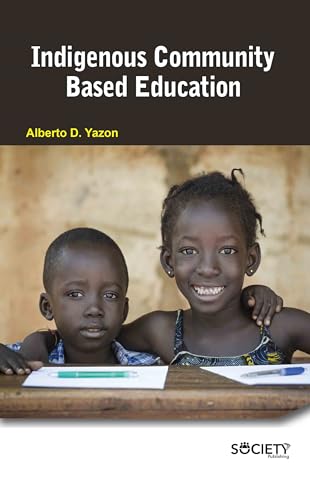
Indigenous community based education / by Alberto D. Yazon.
Material type: TextPublication details: Burlington, ON : Society Publishing, c2022.Description: xix, 239 pages : col. illus. ; 24 cmISBN:
 - 9781774691090
- Fil 370.117 Y29i 2022
| Item type | Current library | Collection | Call number | Status | Barcode | |
|---|---|---|---|---|---|---|
 Books
Books
|
ASCOT Library - Zabali Campus Filipiniana | Filipiniana | Fil 370.117 Y29i 2022 (Browse shelf(Opens below)) | Available | Fil3701104954 |
Browsing ASCOT Library - Zabali Campus shelves, Shelving location: Filipiniana, Collection: Filipiniana Close shelf browser (Hides shelf browser)

|
No cover image available No cover image available | No cover image available No cover image available |

|

|

|

|
||
| Fil 303.483 Al21s 2022. Science, technology and society / | Fil 305.8 J63 1998 Filipino indigenous ethnic communities: patterns, variations, and typologies | Fil 306.83 J63 1998 Filipino social organization: traditional kinship and family organization | Fil 370.117 Y29i 2022 Indigenous community based education / | Fil 371.26 Ar18l 2020 LET comprehensive reviewer LET-TOS and PPST-based specialization : English book 3 / | Fil 371.26 F11l 2020 LET comprehensive reviewer LET-TOS and PPST-based specialization : Filipino / | Fil 371.26 M31l 2020 LET comprehensive reviewer LET-TOS and PPST-based specialization : Mathematics / |
Includes bibliographical references and index.
Contents:
Chapter 1. Indigenous Education: An Introduction. --
Chapter 2. Indigenous Community-Based Education: A Framework for Educators . --
Chapter 3. Community-Based Language Learning (CBLL). --
Chapter 4. Education and Culture. --
Chapter 5. Indigenous People, Identity, and Education. --
Chapter 6. Education and Religion. --
Chapter 7. Life-Long Learning and Knowledge Society.
"Indigenous education is a local decision-making framework in food security, human and animal health, education, natural resource management, and other important economic and social activities. Indigenous peoples have the right to maintain, control, protect and develop their cultural heritage, traditional knowledge, and traditional cultural expressions, as well as their scientific, technological, and cultural expressions, including the characteristics of human and genetic resources, seeds, medicines, animals and plants, oral tradition, literature, design, traditional sports and games, and visual and performing arts. The book presents and develops the notion of community-based education as a means of combating this tendency. Some examples of indigenous community-based education are examined, and there is a discussion both of its distinctive features and underlying principles, and its potential impact on the education of indigenous students."-- Provided by publisher.
There are no comments on this title.